Logo
Insights Logo
Working Papers
Complimentary CONTENT

The Fallacy of Concentration

October 14, 2025
By: Mark Kritzman, David Turkington

By Mark Kritzman, and David Turkington


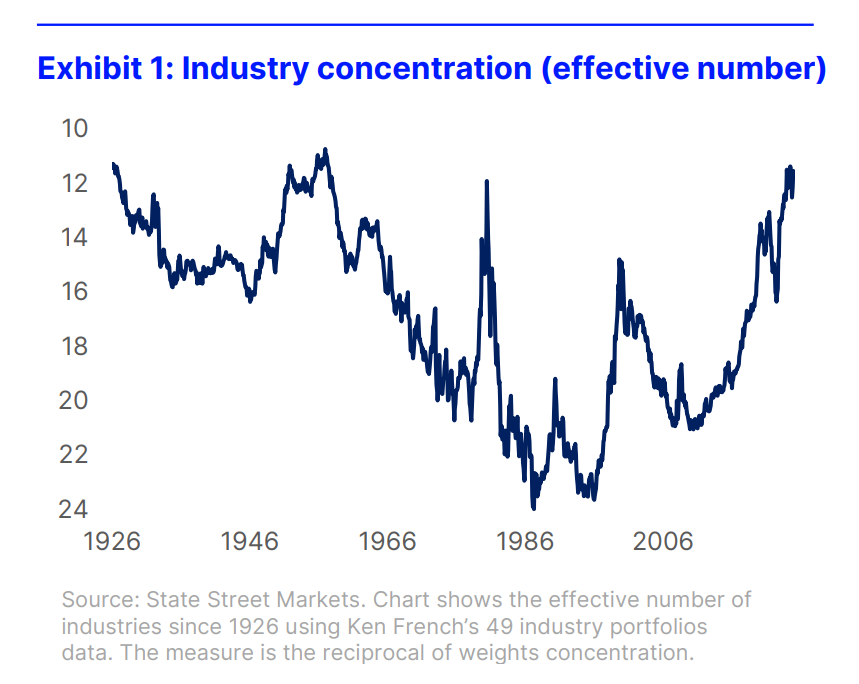
Evidence shows that concentrated market capitalization weights do not make an index riskier, because larger stocks are inherently more diversified and their increased weights are offset by their lower volatility compared to small stocks.


The dominance of large tech firms in market-cap-weighted indices has sparked recent concern about concentration risk, but historical data and empirical analysis suggest these fears may be unfounded. A review of nearly 90 years of market performance shows that reducing exposure based on concentration offers no timing advantage and actually worsened returns and risk. Sector-level concentration also fails to distinguish between high and low risk or strong and weak performance. Moreover, large companies tend to be safer due to their more diversified operational footprint and the increased investor and regulatory scrutiny they receive. Ultimately, the presence of concentrated capitalization weights has not proven to be a reliable indicator of bubbles or future market downturns.


 

READ THE 1-PAGE SUMMARY

Author Bios
Mark Kritzman
Mark is a founding partner of State Street Associates and senior lecturer at the MIT Sloan School of Management. As the author of seven books and more than 100 research articles, Mark has pioneered new approaches to asset allocation, investment strategy, and predictive analytics. He received the James R. Vertin award from the CFA Institute recognizing the relevance and value of his research to the investment profession. Mark’s contributions provide State Street clients with novel practical methods to improve the effectiveness of predictions and investment processes.
David Turkington
David Turkington is Senior Managing Director and Head of State Street Associates, State Street Markets’ decades-long partnership with renowned academics that produces innovative research on markets and investment strategy. David is a frequent presenter at industry conferences, has published more than 40 research articles in a range of journals, and serves on the editorial board of the Journal of Alternative Investments. He is the co-author of three books including “Asset Allocation: From Theory to Practice and Beyond” and “Prediction Revisited: The Importance of Observation.” His published research has received the 2010 Graham and Dodd Scroll Award, five Bernstein-Fabozzi/Jacobs-Levy Outstanding Article Awards, the 2013 Peter L. Bernstein Award for best paper in an Institutional Investor journal, the 2021 and 2023 Roger F. Murray First Prize for outstanding research presented at the Q Group seminars, and the 2022 and 2023 Harry Markowitz awards for best paper in the Journal of Investment Management.
State Street Logo
1. Peter L. Bernstein Award for Best Article in an Institutional Investor Journal in 2013; Bernstein-Fabozzi/Jacobs-Levy Award for Outstanding Article in the Journal of Portfolio Management in 2006, 2009, 2011, 2013 (2), 2014, 2015, 2016, 2021; Graham & Dodd Scroll Award for article in the Financial Analysts Journal in 2002 and 2010. Roger F. Murray First Prize for Research Presented at the Q Group Conference in 2012, 2021, 2023. Harry M. Markowitz Award for Best Paper in the Journal of Investment Management in 2022, 2023. Doriot Award for Best Private Equity Research Paper in 2022.